Iron-Haven Adventure
Genre: Single Player / Action Adventure
Engine: Unreal Engine 5
Assets Used: IWALS-Jakub, Level Design Kit, Synty Studios
Play-tests: #6
Iterations: #6
Duration: 10 weeks
Role: Level Designer
Iterations Overview
Design Intent


Each section was built to gradually increase tension while giving players choices in movement, observation, stealth, and engagement.
Design Goals
-
Deliver a focused third-person level experience within the target gameplay time.
-
Support player agency through multi-route navigation and vertical traversal options.
-
Use Blueprint scripting to implement encounters, interactions, and scripted level moments.
-
Reinforce story through district identity, atmosphere, and scripted moments.
Level Overview & Technique Highlights

Introduction
Ironhaven Heist follows a skilled infiltrator searching for a stolen heirloom in a corrupt medieval port town.
The highlights below break down how traversal, guidance, pacing, and environmental storytelling shaped the player experience.
Highlight 1: Vertical Traversal & Player Choice


Designed traversal routes across ground and rooftops to support player agency, stealth , and environmental exploration.
Execution:
-
Built interconnected traversal spaces with varying risk and visibility
-
Used elevation to create safer observation and infiltration routes
-
Allowed players to naturally bypass or engage encounters through route selection
Highlight 2: Guiding Players Through Environmental Cues


Used environmental framing, lighting, and recurring landmarks to guide navigation without relying heavily on UI markers.
Execution:
-
Reinforced player direction through repeated visual landmarks and framing.
-
Used sightlines and vista moments to establish long-term orientation
-
Directed player attention through framing, lighting, and environmental composition
Highlight 3: Pacing Through Spatial Contrast


Used spatial contrast, environmental compression, and traversal pacing to create shifts between tension, exploration, stealth, and release throughout the level.
Execution:
-
Alternated between open spaces, tight corridors, and controlled reveals
-
Used environmental compression and expansion to shape player tension
-
Varied visibility and movement freedom to create pacing rhythm
Highlight 4: Storytelling Through District Identity


Used architecture, environmental density, lighting, and spatial composition to communicate narrative tone and create distinct district identities.
Execution:
-
Designed each district with unique environmental language and gameplay tone
-
Used lighting, props, and structural decay to reinforce narrative context
-
Created visual contrast between districts to strengthen progression and atmosphere
-
Reinforced emotional pacing through environmental identity shifts
Walk-through & Level Beats
Select a beat below to view its gameplay breakdown.
INTRO — Arrival at Ironhaven
Purpose: Establish the player’s identity, motivation, and tone.
Intent: Set up the story, mood, and long-term destination.
-
Player arrives by steamboat at Ironhaven’s damaged outer port.
-
Intro text frames the player as a lone investigator searching for a stolen heirloom.
-
Smoke, unrest, missing contact R, and guard-tower views establish danger and direction.
Process and Breakdown
Overview




1. Research, Ideation & Planning
-
Game Analysis: Studied Red Dead Redemption 2, Dying Light, and God of War for level flow, vertical traversal, landmark readability, and open-ended linear progression.
-
Real-World Research: Referenced historic port cities, especially Dubrovnik, to shape street density, elevation changes, architectural scale, and believable navigation routes.
-
Design Application: Applied the research to build Ironhaven as a corrupt medieval port town focused on vertical exploration, district contrast, environmental storytelling, and guided player movement.
2. Design Documentation

-
LDD: Defined the narrative setup, objectives, mechanics, district structure, tone, and gameplay direction.
-
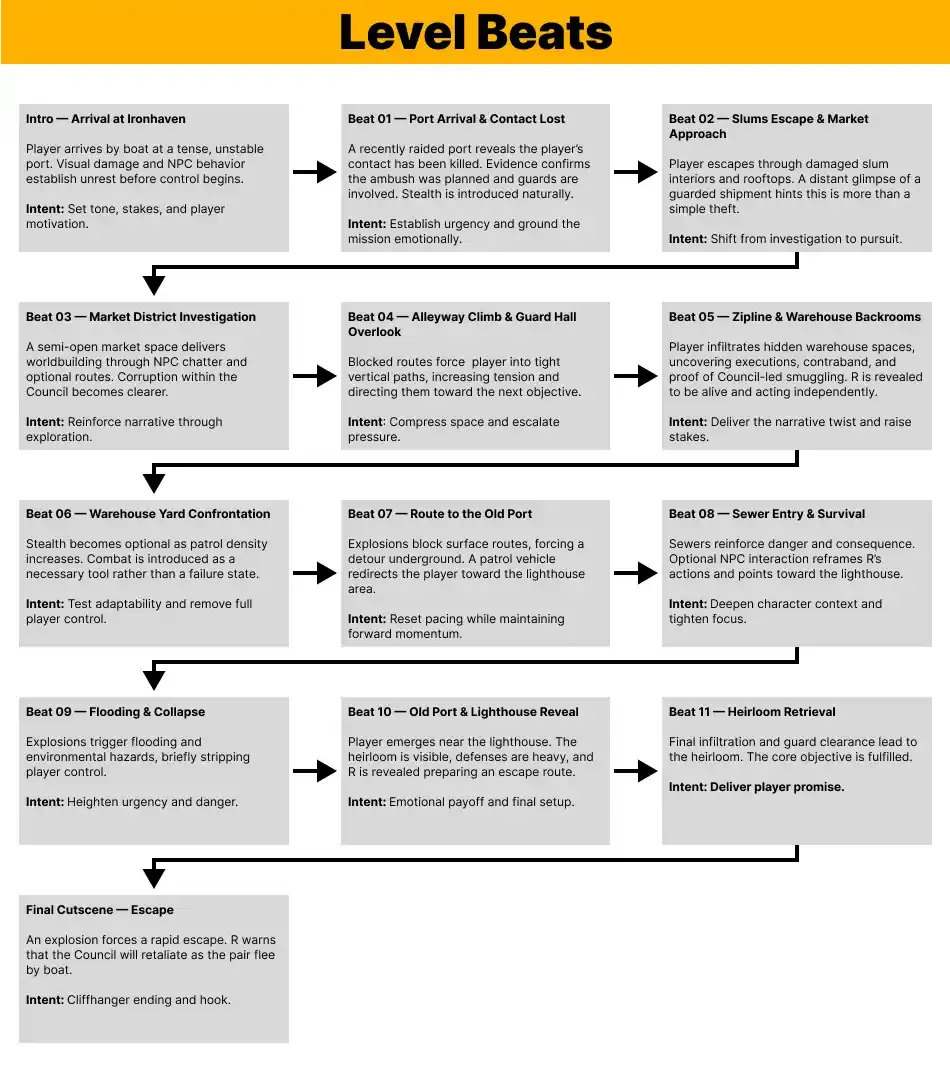
Beat Sheet: Mapped each level section by gameplay type, including stealth, traversal, combat, investigation, and story.
-
Pacing Plan: Tracked escalation, cooldowns, and transitions between exploration, stealth, combat, and high-intensity moments.
-
2D Map Layout: Communicated player flow, district relationships, traversal routes, and major progression beats through a clear top-down layout.
3. Blockout and Iterations Summary
-
Built a simple 3D blockout from the 2D layout to evaluate scale, flow, and readability.
-
Adjusted corridor widths, open areas, ledges, and traversal spaces to better match pacing goals.
-
Tested movement, stealth, and traversal mechanics directly inside the layout.
-
Walked through the level repeatedly to check guidance, route clarity, transitions, and pacing.
-
Identified areas that needed stronger framing, clearer traversal cues, and better contrast between open and compressed spaces.
Select an iteration to view the blockout, playtest, and design changes for each pass.
1. Structuring Key Locations
Define major locations and improve flow between the Market, Guard Hall, Sewers, and Warehouse.
What I did:
-
Rebuilt the layout with tighter spaces and clearer transitions.
-
Defined stronger entry and exit points for key locations.
-
Added early vertical variation to reduce flatness.
Result:
-
The level structure became easier to read and navigate.
-
Player flow improved between exploration, traversal, and guarded spaces.
Feedback:
-
Some areas still felt too open and flat.
-
Key locations needed stronger identity, landmarks, and spatial contrast.


Final Iteration and Gameplay
At this stage, the level structure was stable and the core gameplay flow was locked. The final pass focused on clarity, visual quality, and moment-to-moment impact without major design changes.
-
Added environmental detail, props, and set dressing to complete each space.
-
Refined small layout and pacing issues from final playtest feedback.
-
Improved lighting and visibility for navigation, readability, and mood.
-
Added camera shake and impact effects for explosions and collapse moments.
Final Iteration
Through six iterations and playtests, the level evolved from a simple blockout into a focused and complete experience. Each pass addressed specific problems — from layout clarity and traversal tension to combat structure and pacing.
The process refined not only the spaces, but also how players move, read, and understand the level. Early issues such as flatness, unclear guidance, and low engagement were gradually resolved through structural adjustments, AI updates, narrative support, and final polish.
By the final iteration, the level achieved its intended flow, supported multiple playstyles, and delivered a clear narrative arc within the target gameplay time.
This project was a major step in my growth as a Level Designer, helping me shape a practical end-to-end workflow and build a complete case study of my design process.